
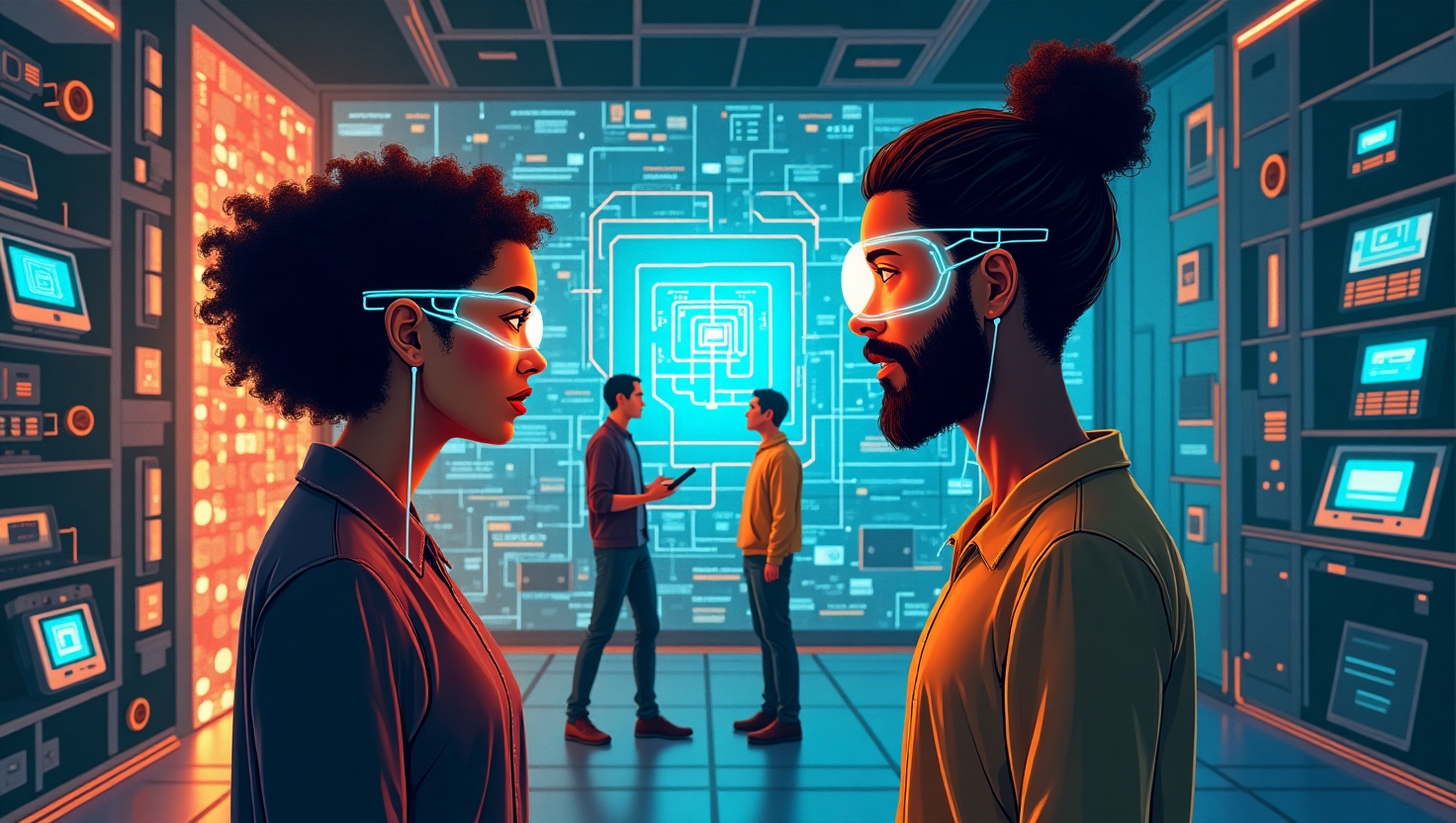
The Rise of AI Vision Systems: Transforming the Evolution of Machine Perception
Introduction
Artificial Intelligence (AI) has made significant strides across multiple facets of technology, and among these, AI Vision Systems stand out as a revolutionary force. These systems have the capability to observe, interpret, and understand visual stimuli in a manner akin to human perception. As we delve into the intricate field of AI Vision Systems, we find a fascinating intersection with evolutionary biology, offering insights into how machine perception is evolving alongside biological paradigms. This blog post aims to explore the advancements in AI Vision Systems, anchoring them in the context of evolutionary processes that mirror the development of vision in the natural world.
Background
AI Vision Systems have undergone remarkable evolution from their primitive beginnings in simple image recognition tasks to executing complex operations such as real-time object detection and scene understanding. Their development trajectory parallels the natural evolution of sensory systems, which has been studied extensively in evolutionary biology. Understanding the biology of vision systems provides crucial insights into AI development, as the stimuli and environmental interactions that shaped biological evolution offer a blueprint for creating advanced AI models.
Prominent research from institutions like MIT underscores this connection, particularly their work on AI agent simulation. This research acts as a pioneering exploration of evolutionary processes through what they describe as a ‘scientific sandbox.’ By simulating how different tasks influence the development of visual capabilities in AI, researchers like Kushagra Tiwary and Brian Cheung are opening new pathways to enhance sensor and camera design in robotics and AI applications MIT News.
Current Trends in AI Vision Systems
The field of AI Vision Systems is witnessing rapid advancements characterized by research breakthroughs and innovative applications. Research advancements have led to more sophisticated models capable of not just recognizing static images but also interpreting dynamic environments. This progress is linked closely with the rising focus on embodied AI agents that simulate evolutionary processes, a concept drawing heavily from the principles of evolution observed in the natural world.
Furthermore, task-driven evolution—where AI is trained to perform specific tasks, mimicking the ‘survival of the fittest’ seen in natural evolution—shows great promise. Such processes allow for the fine-tuning of AI models to perform vision-related tasks with enhanced precision and adaptability, a critical aspect for applications like autonomous vehicles and intelligent surveillance systems.
Insights from Recent Research
MIT’s recent endeavors encapsulate a holistic approach to understanding AI vision systems. Their research not only offers profound insights but also sets a precedent for future exploration in this domain. The ‘scientific sandbox’ approach allows for the experimental development of vision systems by simulating evolutionary trajectories, echoing how organisms have adapted to their environments over millennia.
Kushagra Tiwary noted, “While we can never go back and figure out every detail of how evolution took place, in this work we’ve created an environment where we can, in a sense, recreate evolution…” This environment facilitates testing various evolutionary strategies, providing vital data that could refine the design of AI sensors MIT News.
Additionally, Brian Cheung emphasized the efficiency of these simulations, remarking on the futility of expanding AI agents needlessly: “At some point, a bigger brain doesn’t help the agents at all, and in nature that would be a waste of resources.” These insights promise enhancements in AI system efficiency and effectiveness.
Future Forecast of AI Vision Systems
As we look to the future, AI Vision Systems are poised for transformative developments that will likely redefine a host of industries. The integration of AI agents into areas like healthcare, automotive, and public safety promises to deliver smarter, more responsive systems. Innovations in sensor technologies and adaptive algorithms will drive AI toward unprecedented levels of autonomy and intelligence, akin to a biological organism continuously adapting for survival.
Furthermore, as the synergy between evolutionary biology and AI Vision Systems grows, the ethical and societal implications will warrant closer examination. The potential to enhance AI perception to a point where it seamlessly integrates with and understands human actions offers immense opportunities, alongside significant responsibilities.
Call to Action
The fascinating evolution of AI Vision Systems invites ongoing exploration and engagement. Readers are encouraged to delve deeper into this transformational field by accessing detailed research findings and staying informed through subscriptions to insightful AI-focused content. By doing so, we collectively contribute to the innovation that propels AI and its societal applications forward. For those eager to dive into the scientific nuances of these systems, the MIT study serves as an excellent starting point, shedding light on the evolutionary pathways of machine perception.